Skip to content

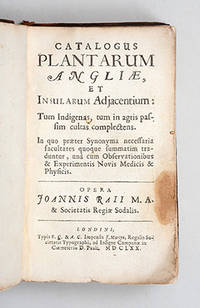
Catalogus plantarum Angliae,

RAY, John.

  • Published: 1670 , London: typis E. C. & A. C. (Ellen Cotes & Andrew Clarke). Impensis J. Martyn,

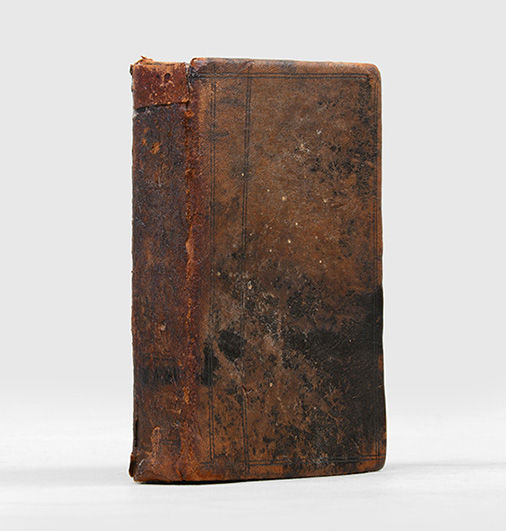
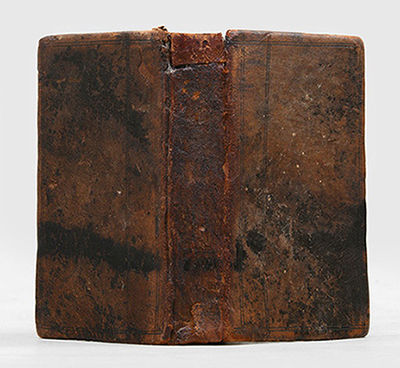
London: typis E. C. & A. C. (Ellen Cotes & Andrew Clarke). Impensis J. Martyn, , 1670. A significant handbook of British plants First edition. "It is now a fairly uncommon book, though this may be partly explained by one of its main purposes, that is, to be used by botanists in the field, so that many copies would probably have been used up and destroyed" (Keynes). John Ray (1627-1705), "the son of a blacksmith, became one of England's greatest naturalists. He was pre-eminently a botanist (he originated the division of plants into monocotyledons and dicotyledons), but also took up the unfinished ornithological work of his friend Francis Willughby" (Oxford Companion to English Literature, fifth edition). "As a result of his tours in Britain Ray acquired a first-hand knowledge of our native flora and he was able to use the material he gathered during these journeys in preparing his Catalogus plantarum Angliae, et insularum adjacentium, published by John Martyn, publisher to the Royal Society. It appeared in 1670 dedicated to Ray's friend Francis Willughby... Ray had no sympathy with the many superstitious beliefs connected with plants, and both in his Cambridge catalogue [1660] and his English catalogue he attacked such credulousness. In the opinion of Raven, Ray's attention to this subject 'did important service in promoting the scientific investigation of the medical use of plants, and combating its age-long association with superstition'" (Henrey). Included here is an "Index morborum & remediorum", a list of botanical cures for various medical problems (Z6r-2A3v); Ray's mother, Elizabeth, was "noted for her piety and her knowledge of medicinal herbs" (ODNB). The co-printer of this first edition was Ellen Cotes, widow of the official printer to the City of London Richard Cotes; she "had a large establishment at her headquarters at the Barbican. Surveyed in 1668, she reported employing three presses, two apprentices, and nine pressmen" (Elizabeth Jane Furdell, Publishing and Medicine in Early Modern England, 2002, p. 108). Duodecimo (156 x 97 mm). Contemporary unlettered sheep, covers ruled in blind, red speckled edges. Contemporary manuscript notes and 19th-century ownership inscription on preliminary binder's blanks, a few later marginal pencillings. Binding rubbed and worn at extremities (rather crudely patched and repaired), running tallow stain to fore edge throughout, initial blank excised (as are pastedowns), tape repair at foot of title, occasional short closed-tears and creasing, worm-trail in gutter at pp. 53-60 affecting a few letters. A good copy, with the final errata leaf. ESTC R15196; Henrey 309; Keynes, John Ray, 7; Charles E. Raven, John Ray, Naturalist: His Life and Works (1950); Wing R381.

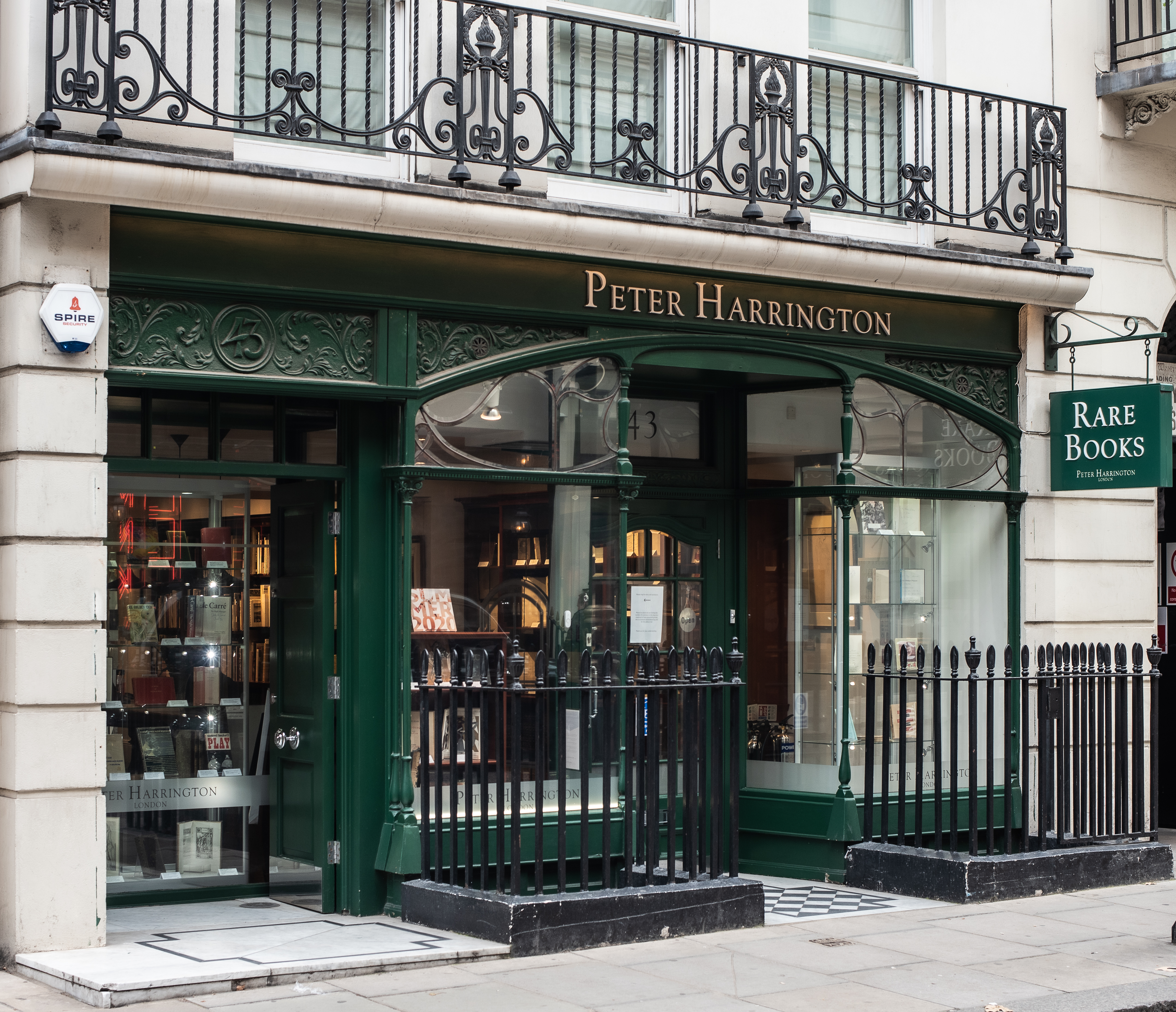
Offered by Peter Harrington

Peter Harrington

100 Fulham Road
Chelsea
London SW3 6HS

Store Hours

Mon-Sat 10.00-6.00

Photo of Peter Harrington
Peter Harrington is one of the most respected and dynamic names in the world of rare books, with permanent galleries in London and New York. From its beginnings in London in 1969, the firm has built an international reputation for sourcing and selling the finest first editions, signed and inscribed books, rare manuscripts, fine bindings, and library sets. Over more than fifty years, Peter Harrington has handled thousands of significant works, from incunabula, early illuminated manuscripts, and Shakespeare folios to landmark works of science, literature, political thought, travel, philosophy, and the arts. As a member of the Antiquarian Booksellers' Association, Peter Harrington offers an unconditional guarantee on the authenticity and completeness of each item it sells,

Terms of Sale for Peter Harrington

All major credit cards are accepted. Both UK pounds and US dollars (exchange rate to be agreed) accepted. Books may be returned within 14 days of receipt for any reason, please notify first of returned goods.