Paris: Delpech, 1830. One of the Rarest of Henri Monnier's Early Lithographic Albums
A Brilliant Satire on the Pretensions, Vanities, and Absurdities of Parisian Society
MONNIER, Henri. Boutades [Jokes]. Paris: Delpech, [1830].
First edition, complete as issued.
Oblong quarto (11 1/8 x 14 3/8 inches; 283 x 365 mm.). Hand-colored lithographic pictorial title-page and six magnificent hand-colored lithographs. Loose, as issued.
The beautifully hand-colored title-page depicts a liveried servant presenting a portfolio of caricatures to the viewer, an appropriate invitation to the gallery of fashionable absurdities that follows.
Preserved in a chemise and fleece-lined half green morocco clamshell case, spine with five raised bands, ruled and lettered in gilt.
An album of extraordinary rarity. No copy has appeared at auction during the past sixty-two. OCLC and KVK locate only one complete institutional copy, at the Getty Research Institute. The Morgan Library preserves an imperfect example from the Gordon N. Ray Collection, lacking both the title-page and Plate II (Dilettanti).
We have handled only one other copy, itself incomplete, lacking Plate III (Idée Riante). The present example is therefore among the very few complete copies known to survive.
Henri Monnier occupies a unique position in the history of nineteenth-century French caricature. Standing chronologically between the Regency caricaturists and the great masters of the July Monarchy - Daumier, Gavarni, Grandville, and Cham - he transformed social satire from political lampoon into an art devoted to the observation of everyday life. His genius lay not in exaggerating appearances but in exposing human vanity, pretension, self-importance, and fashionable affectation through subtle gesture, expression, and situation. Few artists possessed so acute an eye for the comedy of ordinary existence.
Published in 1830, Boutades belongs to Monnier's earliest independent lithographic albums and appeared at precisely the moment when Paris was becoming the unrivaled center of European caricature. The title itself-"Jokes" or "Whims" - perfectly captures the spirit of the work. Rather than political satire, these are comic observations of fashionable society, each transforming an everyday incident into a brilliantly observed theatrical performance.
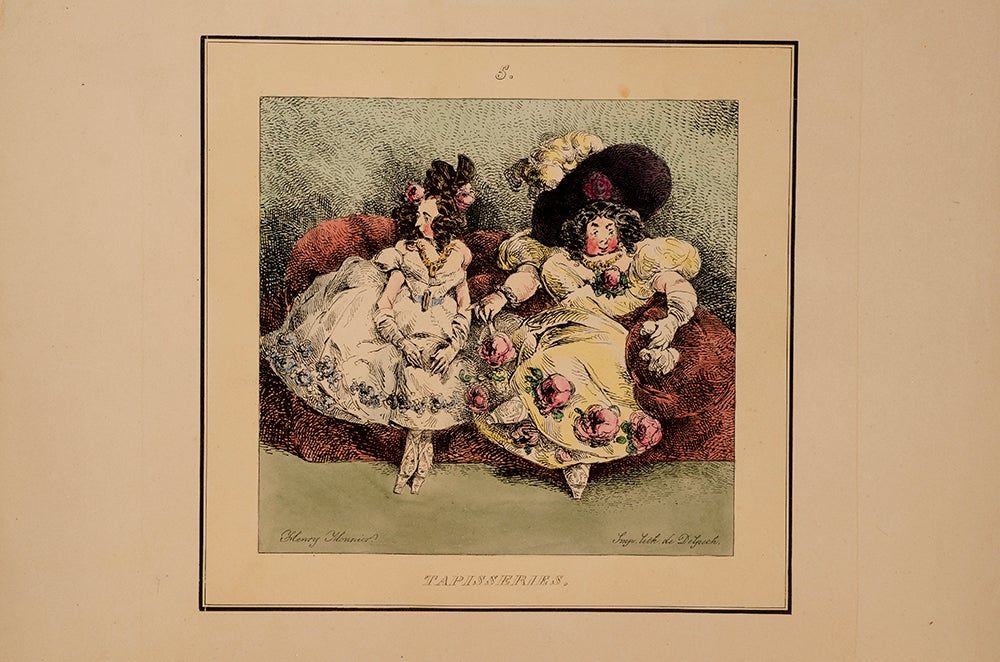
The six lithographs offer a delightful cross-section of bourgeois pretensions. Reading the daily newspaper becomes an elaborate display of self-importance; fashionable amateurs mistake superficial accomplishment for genuine artistic taste; an absurd dandy parades through society convinced of his irresistible elegance; solemn philosophical meditation collapses into comic pomposity; elegant ladies transform fashionable upholstery into an object of exaggerated admiration; and finally, in the celebrated concluding plate, Explosion, Monnier depicts the inevitable catastrophe produced by excessive devotion to fashion, when an over-elaborate toilette literally bursts beyond the bounds of respectability. It is social comedy distilled into visual form, executed with extraordinary economy and wit.
Monnier's caricatures differ fundamentally from those of his contemporaries. They possess none of the savage political edge of Daumier, nor the grotesque fantasy of Grandville. Instead, they derive their enduring appeal from their remarkable humanity. Even at their most ridiculous, Monnier's figures remain sympathetic. He laughs at them rather than condemns them, exposing weaknesses that remain instantly recognizable nearly two centuries later. Fashion, vanity, pretension, social climbing, and the desire to appear clever or cultivated are presented as universal human follies rather than specifically Parisian ones.
Artistically, Boutades represents Monnier at the height of his early lithographic powers. The draftsmanship is economical yet wonderfully expressive, while the contemporary hand-coloring lends warmth and animation to compositions whose apparent simplicity conceals extraordinary sophistication. Every gesture, costume, and facial expression contributes to the narrative, revealing Monnier's remarkable ability to communicate character with only a few precisely observed lines.
The album also occupies an important place in the history of French Romantic lithography. Published by Delpech during the great flowering of Parisian printmaking, it belongs to the first generation of independently issued caricature albums that laid the foundations for the spectacular explosion of illustrated satire during the following decade. Without works such as Boutades, the great albums of Daumier, Gavarni, Cham, and Grandville would scarcely have been imaginable.
Its rarity is exceptional. Unlike Monnier's later publications for Aubert, which survive in reasonable numbers, Boutades appears to have been issued in only a very small edition. Complete copies are virtually unobtainable, making the present example not merely a desirable Monnier album, but one of the great rarities of nineteenth-century French caricature.
An outstanding survival of one of the earliest and rarest masterpieces of French Romantic lithography.
The Plates:
La Lecture du Journal - Reading the Newspaper
Dilettanti - Fashionable Amateurs
Idée Riante - Cheerful (or Pleasant) Idea
Méditation - Meditation
Tapisseries - Tapestries
Explosion - Explosion
Bobins V, 1546; Marie 454-460; not in Abbey; not in Tooley; not in Melcher.